slide 1
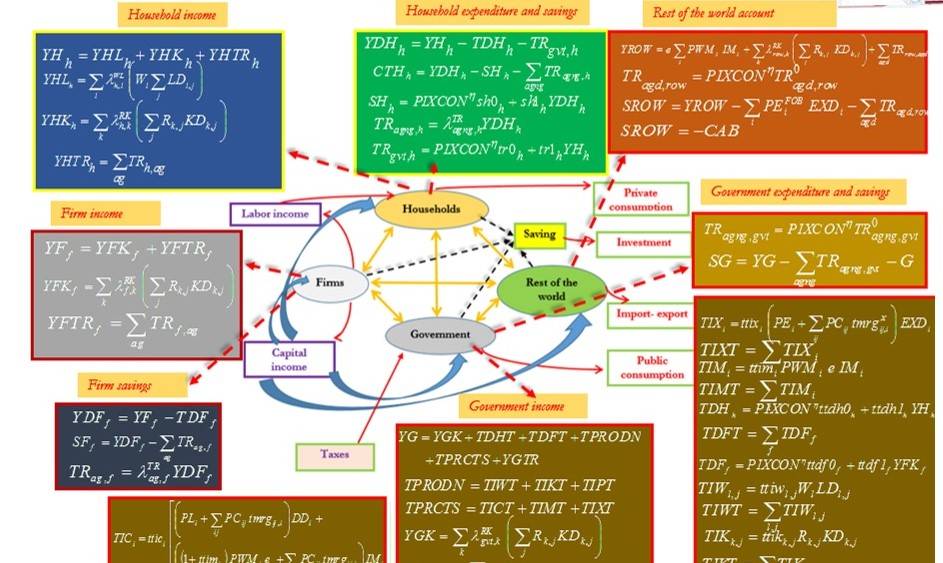
Introduction to Static CGE Modelling
previous arrowprevious arrow
next arrownext arrow
Introduction to Static CGE Modelling
Advanced Dynamic CGE Modelling
Introduction to IOT/SUT Multiplier Modelling
Statistical Construction of IOT, SUT And SAMs
Integration of NCA, Biodiversity, and Nature into National Accounts
Macroeconomic modelling of NCA and Carbon Emissions
Introductory to DSGE Modelling in Matlab
Advanced DSGE Modelling course
  Macro-econometric Modelling and Forecasting in Eviews
  Introduction to building Micro-simulation models in Stata
previous arrow
next arrow
Shadow

Upcoming Events

Date. 6th -10th April 2026

Venue. Nairobi Kenya

Integrating NCA, Biodiversity and Nature in National Accounts

Date. 4th - 10th May 2026

Venue. Dar-es-Salaam Tanzania

Macro-economic Modelling of Natural Capital Assets (NCA) and Carbon Emissions

Date. 29th June - 3rd July 2026

Venue. Lusaka Zambia

Construction of input- output tables (IOT), Supply and Use Tables (SUT) and social accounting Matrices (SAM)

Date. 6th-10th July 2026

Venue. Lusaka Zambia

Introduction to CGE Modeling 
Welcome To MacroSolve School

We are trusted school of economic modelling.

We offer programs with hands on skills in building CGE, DSGE, Macro/Micro econometric, SUT/SAM Multipliers and Natural Capital Assets (NCA) and Climate Change models

Our Courses

Courses

This introductory course in Computable General Equilibrium (CGE) modelling provides rigorous training in static open-economy CGE frameworks using GAMS. 

The Advanced Dynamic CGE course is an intensive extension of the introductory CGE training, designed to equip participants with advanced skills in developing and customising Dynamic CGE models for individual economies.

The course aims to equip participants with analytical skills in multiplier-based analysis of Input–Output (I-O) Tables and Supply and Use Tables (SUT), using aggregated macro-level matrices to examine

The Advanced SUT/SAM Multiplier Modelling Course is an intensive extension of the Introductory Input– Output and Supply and Use Tables (I-O/SUT) Multiplier Modelling programme,

This course focuses exclusively on the statistical development and compilation of Input–Output Tables (IOTs), Supply and Use Tables (SUTs), and Social Accounting Matrices (SAMs),

The introductory course on integrating Natural Capital Assets (NCA), biodiversity, and nature into National Accounts (like GDP-based frameworks), is a hands-on short course designed to strengthen the capacity

Introduction to Econometric course is intended for policy makers, researchers, students of applied economics and institution who intend to begin their career of using Econometric modeling for research and policy guidance. The course focuses on the use of published econometric theory by putting it in practice on applied country specific data.

The Introductory Course on Dynamic Stochastic General Equilibrium (DSGE) Modeling is a hands-on training programme designed to equip policymakers, central bank staff, statisticians, researchers, and graduate-level

This advanced course builds on the foundational concepts introduced in the Introductory DSGE Modelling course and equips participants with rigorous analytical and computational skills required for the specification

This course extends the standard DSGE modelling framework to incorporate environmental and climate-related macroeconomic dynamics for policy-relevant analysis. It equips participants with the technical skills

The Introductory Course in Macro-econometric Modelling Using EViews is a hands-on applied training designed to equip policymakers, macro-fiscal analysts, central bank staff, researchers, and graduate students

Micro-simulation modelling is an essential analytical tool for assessing the distributional and welfare effects of macroeconomic and fiscal policies using household-level survey data. Unlike macro-structural frameworks such

This advanced course builds directly on the introductory Course in Micro-Simulation Modelling, extending participants’ capacity from basic static welfare analysis to behaviourally-consistent policy simulations using

Our Professional Skill’s

Professional Skill of Macro Solve.

CGE Modeling
79%
DSGE Modeling
80%
Tax Policy Analysis & Modeling
85%
Climate Change Modeling
82%
Natural Capital Asset (NCA) Modelling
84%
Macro-Econometric Analysis & Forecasting Modeling
81%
SUT/SAT Multiplier Modeling
79%